Beyond the Reed Diffuser: A Proper Design Plan for the Downstairs Loo
There’s a particular kind of UK hallway that tells you everything about a house before you’ve reached the kitchen. The coat hooks are tidy, the runner is straight, and then there’s the downstairs loo: a leftover mirror, a scented reed diffuser doing heroic work, and a hand towel that has clearly been through several Christmases. It’s not a disaster. It’s just a missed opportunity.
The smallest room in the house has the loudest voice. Guests are in there alone, with nothing to look at but your choices. They notice the light, the tap, the wallpaper, the art. They notice whether the room feels considered or whether it feels like the place where spare toilet rolls and apologetic decorating decisions go to live. And because it’s small, you can take a bolder swing than you might dare in the living room. A downstairs cloakroom is not a bathroom. It’s a moment.
Start with a point of view, not a theme
The temptation is to treat the loo as a mini bathroom: blue-and-white tiles, a shell-shaped soap dish, something nautical. Resist. A theme is not a point of view. A point of view is a decision you can repeat: deep colour, warm brass, a print that makes people smile, a basin that looks like it was chosen on purpose. In a room this compact, one clear idea goes further than five polite ones.
Think of it as a jewellery box rather than a spare room. You don’t need much, but what’s there should earn its place. That might mean a rich green or inky blue on the walls, a slim console basin, a proper mirror with a frame, and a single framed print. Or it might mean a joyful wallpaper, a simple white basin, and a light that flatters everyone. The room doesn’t need to match the hallway exactly. It needs to feel like it belongs to the same house — just with a little more nerve.
Bold wallpaper earns its keep in a tiny room
People often say wallpaper is wasted in a small room. The opposite is true. In a downstairs loo, wallpaper is the main event. You see it all at once, from a metre away, and then you’re out again. That’s not a commitment; it’s a cameo.
Choose a pattern that works at close range. Big florals can be lovely, but in a narrow cloakroom they can feel like standing too near a curtain. Smaller repeats, gentle geometrics, a painterly stripe or a slightly mischievous motif all hold their own. If the room is dark and windowless, a warm mid-tone with a soft pattern will feel enveloping rather than gloomy. If there’s a small window, let the wallpaper respond to the light — nothing too cold, nothing that turns muddy at 4pm in November.
And do paper the ceiling if you’re feeling brave. It sounds excessive; it rarely is. In a tiny room, a papered ceiling blurs the edges and makes the space feel intentionally wrapped rather than boxy. If that’s a step too far, paint the ceiling the same colour as the walls and let the wallpaper do the talking below.
A proper light changes everything
Most downstairs loos are lit like a stationery cupboard. A single flush ceiling light, usually with a cool bulb, is enough to make anyone look tired and every tile look slightly wrong. Swap it. A wall light or a pair of small wall lights at face height is far kinder, and a pendant with a warm bulb can make the room feel like a proper little interior.
Aim for warm white — around 2700K — and put it on a dimmer if you can. You don’t need to light the whole room brightly; you need to light the basin and the face of whoever is washing their hands. A mirror light or a slim wall light beside the mirror is the practical, flattering choice. If there’s no natural light, add a small lamp on a shelf or a rechargeable wall light. It sounds fussy for a loo. It also makes the difference between a room that feels like an afterthought and one that feels like a treat.
The compact basin deserves better than a pedestal
Pedestal basins are fine, but they’re often the reason the room feels like a spare bathroom. A compact cloakroom basin — slim, wall-hung, maybe with a small shelf or a console frame — gives you somewhere to put the soap and a bit of breathing space underneath. It also makes the room look more deliberate. You’re not trying to fit a full bathroom into a cupboard; you’re giving the cupboard a proper basin.
Choose a tap you actually like. In a small room, the tap is a piece of sculpture. A brushed brass or warm nickel mixer will catch the light and add a bit of polish. Keep the soap dispenser simple and refillable; a mismatched plastic bottle undoes a lot of good work. And hang the hand towel on a proper ring or rail rather than balancing it on the side of the basin. Small rooms are won on details.
One confident piece of art, not a gallery
The downstairs loo is not the place for a collection of six small prints in a row. It’s the place for one piece that makes people pause. A bold abstract, a vintage botanical, a photograph with a bit of wit, a small painting you found at a market — anything with a bit of personality. Hang it at eye level, opposite the door if possible, so it’s the first thing guests see when they walk in.
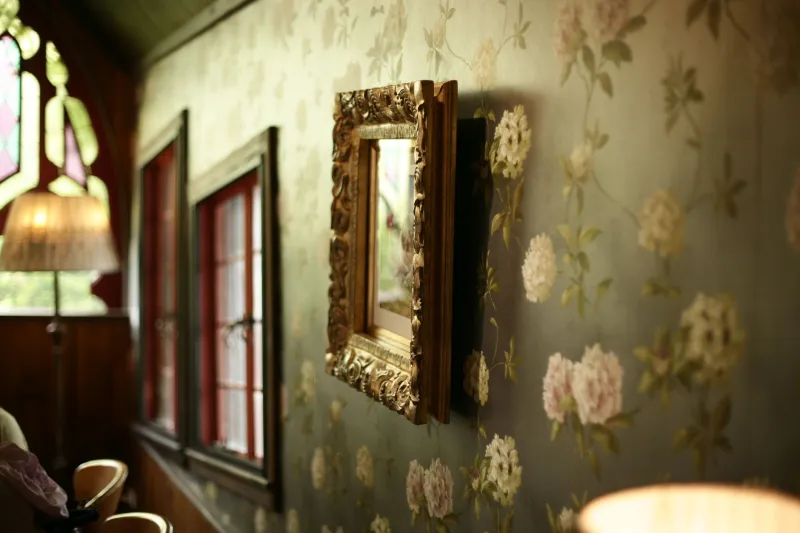
If the wallpaper is busy, keep the art simple and the frame strong. If the walls are plain, go louder with the art. And don’t forget the mirror. A plain builder’s mirror is the single most common giveaway that a downstairs loo has been neglected. Swap it for something with a frame — wood, brass, lacquer, even a slim painted edge — and the room immediately feels more resolved.
Make it practical, then make it memorable
A downstairs loo still has to work. Check the extractor fan, or add one if there isn’t one. Make sure the bin has a lid and the toilet roll holder is actually fixed to the wall. A small shelf above the basin can hold a candle, a spare roll and a small vase, but don’t clutter it. In a room this size, every object is visible, so edit hard.
Scent is the final layer, but it shouldn’t be the only layer. A candle, a diffuser or a small dish of dried stems is lovely; a room that relies on scent to distract from a sad mirror and a cold bulb is not. Get the bones right first — wallpaper, light, basin, art — and the finishing touches will feel like a welcome rather than a rescue.
The downstairs loo is never going to be the biggest room in the house. It can, however, be the one guests mention on the way out. Give it a proper point of view, and it will repay you every time someone closes the door and thinks, ‘Oh, that’s nice.’