The Blank Wall Defence: Why Unfinished Corners Make a UK Home Feel Finished

Photo: Pedro Ribeiro Simões from Lisboa, Portugal, CC BY 2.0, via Wikimedia Commons
There is a particular kind of confidence in a house that has a wall doing nothing at all. Not a wall that's been given over to something sensible — not a bank of shelving, not a gallery wall, not a statement paint job — but a genuinely, deliberately empty one. Bare plaster with a faint map of old filler. A picture rail with three hooks and nothing hanging from them. A rectangle of paint a shade brighter than everything around it, because a mirror used to live there and a better one hasn't turned up yet.
That wall is not a failure of imagination. In a growing number of UK homes, it's the most interesting thing in the room.
We've had the show-home look. It was lovely. It was also a bit exhausting.
For the best part of two decades, the aspirational interior has been a finished one. Cushions plumped to a formula. Books aligned to a colour palette. Artwork hung at a prescribed height, spaced to a prescribed gap, photographed from a prescribed angle. There is nothing wrong with any of it — a well-resolved room is a pleasure to sit in — but the formula has become so familiar that it's begun to read less like taste and more like compliance.
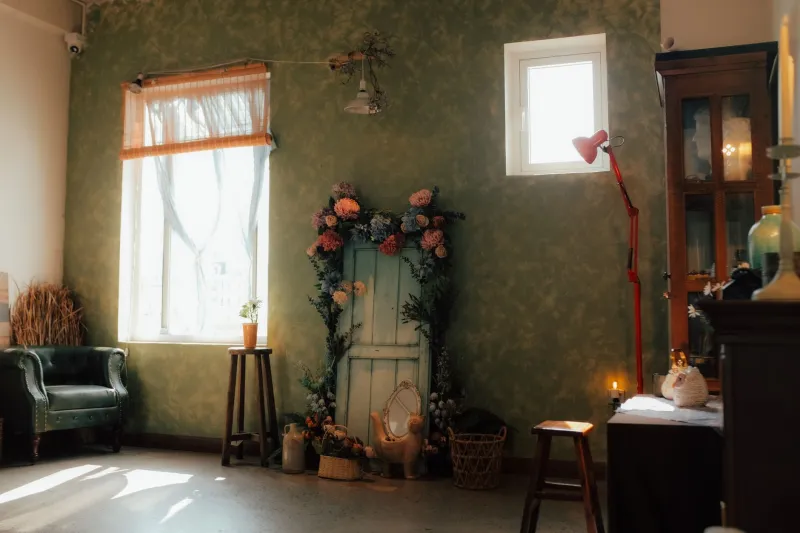
What people actually stop and screenshot now is different. It's a corner with one good chair, a lamp that doesn't quite reach it, and a stretch of wall above that has clearly been left alone. It's a Victorian terrace sitting room in which the only thing on the chimney breast is the ghost of a picture that hasn't been bought yet. It's the spare room with a gap where the mirror should be, and the room is better for it.
Deliberate incompleteness is not the same as neglect. That distinction is the whole argument.
Why an empty wall reads as expensive
A blank wall does three useful things at once. It gives the eye somewhere to rest, which is rarer and more valuable in a small British room than another object to look at. It frames whatever sits beside it — a sofa, a sideboard, a lamp with a proper shade — by giving that piece a plain backdrop to perform against. And it signals that the room belongs to someone who isn't in a hurry.
That last point is the subtle one. A home where every surface is resolved looks like a project that has been completed. A home with one unresolved wall looks like a life that is still being lived. Buyers, guests and the people who actually have to dust the place all respond to the second version more warmly, even if they can't say why.
There's also a practical honesty to it. Most of us are not going to find the perfect piece for every metre of wall in a single decade, let alone a single season. Leaving a wall open is a way of admitting that without the room looking like a hostage situation. It's the interiors equivalent of not filling every silence in a conversation.
Choosing the wall to leave alone
Not every wall is a good candidate, and the wrong one will just look sad. A few things worth considering before you clear a space:
Avoid the first wall you see from the doorway if the room is already on the sparse side. Greeting a guest with a large expanse of nothing can read as a room that hasn't been got to yet, rather than one that has been considered. Better to place the gap to one side, so it's discovered rather than announced.
Choose a wall that flatters your best piece. If you have one properly good thing in the room — a mid-century sideboard, a linen armchair, a decent little lamp table — a blank stretch behind it will make it look twice as considered. Busy wallpaper does the opposite.
Watch the light. A plain wall in a north-facing room can go grey and slightly grim by mid-afternoon. In a room that catches morning sun, or that has a warm lamp nearby in the evening, the same wall looks like a painted backdrop in the best sense. Spend a day in the room before you commit.
Keep it clear of the telly. A blank wall directly opposite the sofa will be read as 'space reserved for a screen' by absolutely everyone who walks in, which is not the note you're going for.
Three details that make a gap look intentional
An empty wall and an abandoned wall look identical until you add one of the following.
Anchor it with something low. A slim console, a bench, a single chair pulled slightly out from the wall. It doesn't need to be tall or expensive — it just needs to tell the eye that the space above was a decision, not an oversight.
Give the wall a job. A picture light with nothing under it yet. A wall-mounted reading lamp. A plug socket where a floor lamp will eventually stand. A hook with one nice bag on it. Any small sign of purpose turns absence into anticipation.
Keep the edges immaculate. Crisp skirting, clean paint lines, no trailing cables, no leaning cardboard. The gap has to be the tidiest thing in the room, otherwise the whole effect collapses into 'we ran out of steam in March'.
The line between unfinished and abandoned
Here's a test that works more often than not. If you can describe what's missing in a single sentence — 'we're waiting for the right mirror', 'the gallery goes up once the plaster's properly cured', 'that wall wants one big thing, not six small ones' — then it's a design decision. If the honest answer is 'we haven't got round to it', it will show, and no amount of styling will disguise it.
The other tell is drift. A deliberate gap stays clear. An abandoned one slowly acquires a leaning picture frame, a bag for life, a bike, a box of things for the charity shop. Once the clutter arrives, the wall has stopped being a pause and started being a storage solution.
The mirror you haven't found yet
There's something quietly lovely about a wall that is waiting. It suggests a house that is still being shaped by the people in it — that the final piece hasn't been bought in a panic from a website at eleven at night, but will one day be spotted in a junk shop in a town you weren't planning to stop in.
British homes have always understood this better than the magazines give them credit for. The Georgian plaster, the Victorian picture rail, the 1930s alcove — they were built for a slow accumulation of things, not a single weekend's styling. Leaving one wall open is simply a return to that. A room doesn't need to be finished to be beautiful. Sometimes it just needs room to breathe, and the confidence to let it.