The Bold Little Room: Why UK Snugs Are Choosing Colour Over Caution in 2026
There is a particular kind of UK room that has spent too long apologising for itself. The box room with the spare desk. The narrow study off the hall. The snug that is really a landing with a door. For years, the default was to keep it light, keep it neutral and hope nobody noticed how small it was. In 2026, the mood has shifted. The smallest room in the house is increasingly the boldest, and colour-drenching is the reason why.
At Emporium Home Interiors, we are all for a calm, creamy living room. But a compact snug is a different brief. It is not trying to be the whole house. It is trying to be one good idea, done properly. And a room with one good idea feels larger than a room with three uncertain ones.
Why the smallest room is suddenly the boldest
A small room painted in a safe pale neutral can feel airy, but it can also feel unresolved. The eye has nothing to hold on to. Deep colour gives a compact space boundaries, atmosphere and a sense of purpose. It says: this room is not a leftover. It is a destination.
Colour-drenching takes that logic further. By painting walls, ceiling, trim and sometimes even the radiator in closely related tones, you remove the visual stops that make a small room feel chopped up. The edges soften. The space becomes a cocoon rather than a corridor. In a UK climate where November afternoons go dark by four, that cocooning effect is not a compromise. It is a luxury.
Choose a colour with a bit of weight
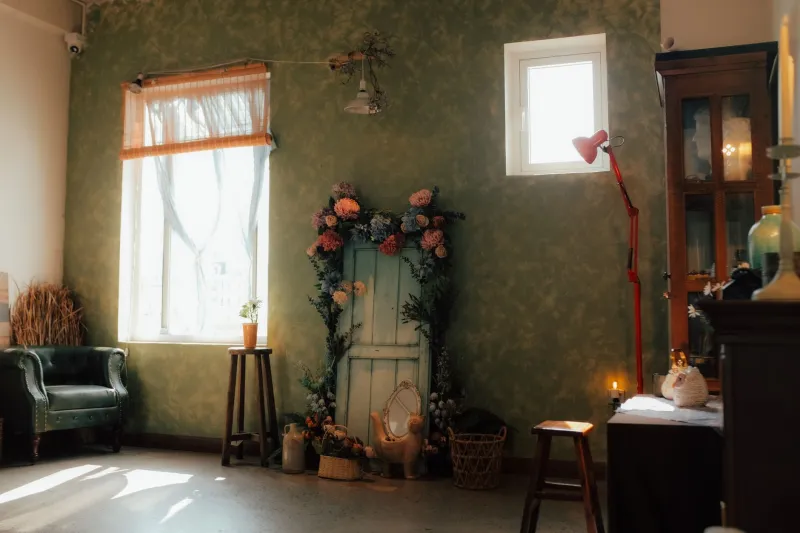
This is not about choosing the loudest colour in the fan deck. It is about choosing a colour with enough pigment to do some work. Think deep olive, ink blue, oxblood, earthy terracotta, warm ochre or a smoky aubergine. These shades feel rich without shouting, and they flatter the warm lamplight we rely on for half the year.
Light matters more than trend. A north-facing snug can carry a warmer deep green or a clay-toned red beautifully, because it needs the warmth. A south-facing room can take a cooler navy or forest green without turning gloomy. Buy sample pots, paint large patches on two walls, and look at them at breakfast, at dusk and under the lamp you actually use. A colour that looks wonderful in the paint shop can look entirely different beside a Victorian sash window.
Finish is part of the decision. A washable matte for walls feels soft and forgiving. An eggshell on woodwork is practical without being shiny. If you have period details, do not fight them. Let the cornice, picture rail and skirting join the colour scheme rather than outlining it in white.
The fifth wall matters
Nothing shrinks a small room faster than a bright white ceiling floating above dark walls. It creates a visual lid. Painting the ceiling the same colour, or one shade lighter, lets the room breathe as a whole. If that feels too much, try a soft tint of the wall colour rather than brilliant white.
Trim is the other giveaway. In a colour-drenched snug, skirting boards, door frames, window reveals and radiators should generally follow the walls. Use a harder-wearing finish on the woodwork, but keep the tone close. This is especially effective in older UK homes where layers of white gloss have turned every edge into a graphic line. Removing those lines makes a compact room feel calmer and more considered.
Furniture that fits without fidgeting
Small rooms do not need small furniture so much as the right furniture. A tiny sofa pushed against a wall can look mean. A generous armchair with a low back, or a compact loveseat with slim arms, can feel far more inviting. Measure the room properly, including the swing of the door and the space you need to walk past with a cup of tea.
Shoppable ideas that earn their keep in a snug:
- A low-backed tub chair or compact loveseat in a textured weave, rather than a deep bulky sofa.
- A small round side table that can tuck beside a chair without blocking the route to the window.
- A slim floor lamp with a fabric shade, placed to cast light across the room rather than over your shoulder.
- A wall-mounted shelf or picture ledge for books, a small vase and one good object, keeping the floor clear.
- A rug that runs close to the walls. In a small room, a rug that is too small makes the space feel like a raft in a puddle.
Layer textiles for warmth, not clutter
Colour-drenching gives you the background. Textiles give the room its welcome. A wool rug in a tone close to the walls adds softness without breaking the scheme. Cushions in velvet, boucle or slubby linen bring texture. A throw over the arm of a chair is not styling for styling's sake; it is the equivalent of leaving a good book on the table. It invites someone to sit down.
Curtains or a Roman blind in a similar tone to the walls will keep the room feeling enveloping. If you want pattern, keep it to one confident cushion or a small-scale print that echoes the paint colour. The point is depth, not decoration for its own sake.
Light it like a room, not a corridor
A single pendant in the middle of a small ceiling does very little for atmosphere. Layer the light instead. A wall light beside the chair, a table lamp on the shelf, a floor lamp in the corner and a picture light over a favourite print will create pools of warmth that make the room feel bigger and more interesting after dark.
Use warm bulbs, around 2700K, and put everything on dimmers if you can. Cool white light will flatten a deep colour and make the room feel clinical. Warm light makes ink blue look velvety and deep olive look almost golden. In a colour-drenched snug, lighting is not the finishing touch. It is half the scheme.
A transformation you can do in a fortnight
You do not need to rebuild the room to change how it feels. Start by clearing it out and living with the empty space for a day. Choose your colour in sample pots, not online. Paint the walls and ceiling first, then the trim. Swap the lampshade for a warmer, softer one. Move the rug so it anchors the seating rather than floating in the middle. Add one statement chair, one good lamp and one piece of art. Then stop.
The temptation in a small room is to keep adding because it feels unfinished. Resist it. A colour-drenched snug works because it is decisive. One deep colour, one comfortable chair, one warm light and a clear floor will always beat a room that is merely full.
The pieces worth buying once
In 2026, the most persuasive small rooms are not the busiest. They are the most intentional. A sculptural floor lamp, a vintage-style armchair reupholstered in a deep fabric, a compact brass side table, a framed print that makes you smile every time you walk past: these are the pieces that justify the bold paint. They do not compete with the walls. They settle into them.
That is the real argument for going dark, deep and all-in on a tiny UK snug. It is not about shock value. It is about giving a small room the same care and conviction as a large one. Paint it properly, light it warmly, furnish it sparingly and let it be exactly what it is: the best little room in the house.