The Warm Frame: Layering Windows for Bright, Cosy Winter Rooms
There's a moment in late autumn when the windows stop being a view and start being a draught. The sofa gets a throw, the floor gets a rug, and yet the glass stays bare until someone gives in and hangs the heaviest curtains they can find. Understandable, but it's how lovely living rooms end up feeling like cinemas by mid-afternoon.
The better approach is layering. Not in a fussy, swagged-and-tailed way, but in the same spirit you'd approach a statement chair or a well-chosen sideboard: a few considered pieces working together, each doing a job. Done properly, winter window treatments add warmth, soften sound and frame the room. They can also keep more light bouncing around than a single thick curtain ever would.
Start with the shape of the window you actually have
UK windows are rarely straightforward. A Victorian terrace might give you a deep bay with a radiator tucked underneath. A Georgian townhouse may have tall sash windows with elegant but draughty reveals. Cottages come with low ceilings, thick walls and windows that sit far back in the plaster. New-builds are often wider and shallower than we expect.
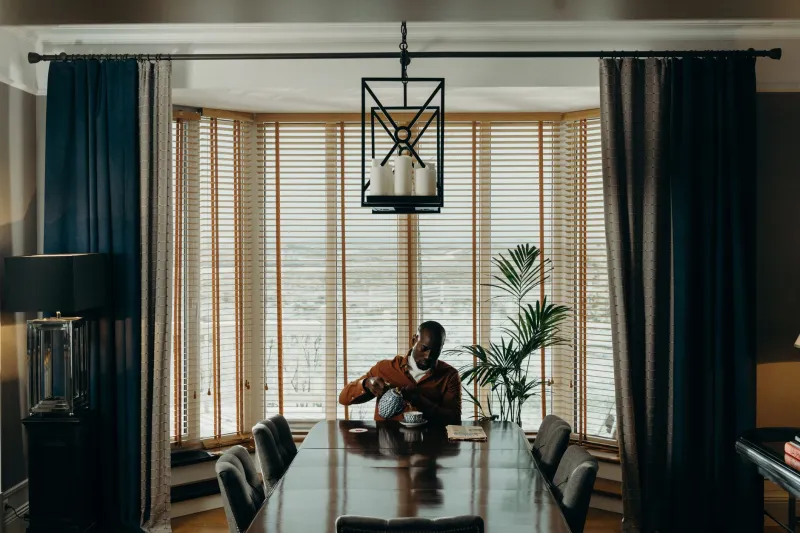
Before you shop, look at the recess. If you have a deep reveal, fit your blind inside it and hang curtains on a pole or track just outside. That way the blind can filter light during the day while the curtains add a soft edge and extra insulation at night. On sash windows, a sill-mounted Roman blind or a slim roller keeps the glazing bars visible, which matters if you love the architecture. On a box bay, a ceiling-fixed track can follow the shape without stealing head height.
And if there's a radiator under the window, don't panic. A sill-length curtain that finishes just below the glass will keep heat moving into the room rather than trapping it behind fabric. A radiator shelf is another quiet win.
The three-layer rule, loosely applied
Think in layers rather than a single heroic curtain. The first layer is light control: a voile, a linen sheer or a café curtain that takes the glare off a screen without blocking the day. The second is texture and insulation: a Roman blind in a woven fabric, or a simple roller in a warm neutral. The third is the outer curtain, ideally lined, which gives the room its finished edge and holds warmth at the glass.
You don't need all three everywhere. In a living room that faces the street, a sheer plus a lined curtain is often enough. In a north-facing room that feels chilly, add the blind. In a bedroom, swap the sheer for a blackout-lined blind and keep the curtains for softness. The trick is to avoid stacking three heavy elements in one place; that's when a window starts to feel barricaded rather than dressed.
Linings, fabrics and the thermal question
Fabric choice matters more than the label on the packet. For curtains, a cotton-linen blend or a wool mix hangs beautifully and feels substantial without being stiff. Velvet is wonderful in a living room or dining room, especially in a muted olive, rust or deep blue, but keep the lining simple so it doesn't become bulky. For blinds, a linen-look weave or a brushed cotton gives a softer finish than a shiny synthetic.
Thermal linings are genuinely useful in older homes, but they vary. A bonded thermal lining or an interlined curtain adds body, reduces draughts and helps with noise. Blackout linings are brilliant in bedrooms; in a living room they can make the window feel flat during the day, so use them only where you actually need darkness. If you're buying ready-made, check the lining composition rather than assuming 'thermal' means thick. And always check the drop: a curtain that puddles on the floor will collect dust and look tired by February.
Pelmets and valances: not just for period dramas
A plain pelmet is one of the most useful winter tools in the room. It hides the track, boxes in the top of the window and stops warm air disappearing up behind the curtain. The mistake is assuming a pelmet has to be gathered, fringed or fussy. A simple fabric-covered board in the same material as the curtains, or a painted wooden pelmet in the wall colour, looks crisp and contemporary. In a period room, a shallow valance in a matching fabric can look properly intentional rather than old-fashioned.
If you rent, or if drilling isn't an option, a ceiling-mounted track with a simple fabric pelmet fixed to a lightweight batten can work without touching the window frame. Just check the fixing first.
Shutters and café curtains: the half-light heroes
Plantation shutters are often sold as a warm-weather solution, but they earn their keep in winter too. Tier-on-tier shutters let you close the lower half for privacy while keeping the top open for light. Full-height shutters add a clean, architectural line to sash windows and bay fronts, and they're particularly good in street-facing rooms where you want privacy without a heavy curtain.
Café curtains are the quieter option. A half-curtain across the lower pane gives privacy from the pavement while the top half stays clear. They work beautifully in kitchens and bathrooms, but also in a living room where you want to soften the window without losing the view. A tension rod means no drilling, which is useful in rentals and period homes with delicate plaster.
Hang high, hang wide, and let the frame do its job
A curtain pole fitted just above the window and extended 15–20cm beyond each side will make the window look wider and the ceiling taller. It also means the curtains can be drawn back clear of the glass during the day, so you keep every bit of light. Eyelet curtains are easy and relaxed; pleated headings look smarter and use less fabric. Whichever you choose, check the pole projection: a deep bay or a radiator shelf may need a longer bracket than you think.
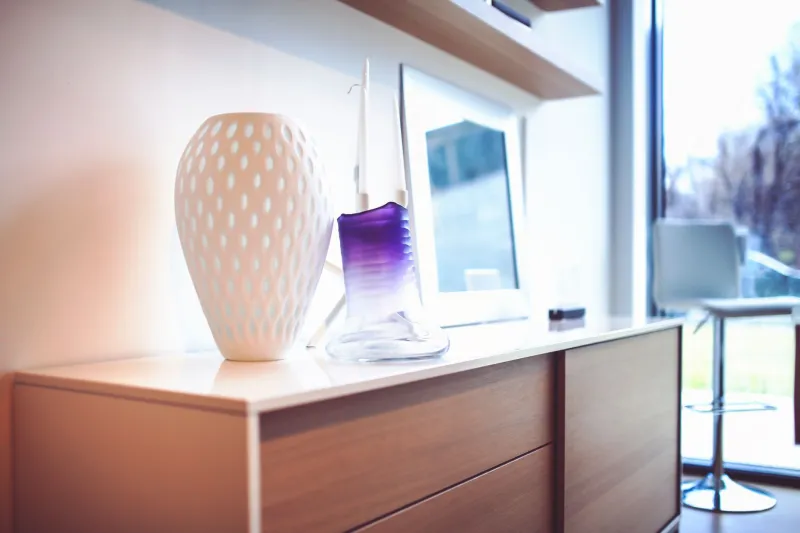
Finally, dress the sill. A small lamp, a ceramic vase or a slim stool in a bay window gives the treatment something to frame, just as a sideboard gives a wall a purpose. It's the difference between a window that's merely covered and one that feels properly finished.
The best winter windows aren't the darkest ones. They're the ones that let you see out, keep the warmth in and make the room feel pulled together before you've even switched on the lamps.