Pull Up a Bench: The Seating Swap That Makes a Compact Dining Room Feel Twice the Size

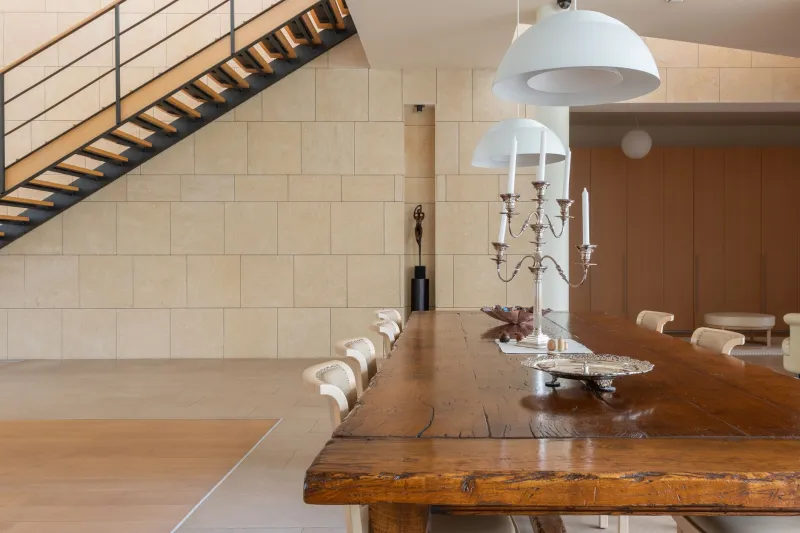
Photo: Elliott Brown from Birmingham, United Kingdom, CC BY 2.0, via Wikimedia Commons
There is a particular kind of British dining room — 3m by 2.8m, a window at one end, a door that opens the wrong way — where six chairs are quietly ruining everything. Not because they are ugly, and not because they are uncomfortable, but because each one demands a little patch of floor behind it that the room simply does not have. You squeeze past, you turn sideways, you put your drink down on the windowsill because there is nowhere else to lean.
The fix is not a smaller table. It is fewer chairs.
Chairs are the space thieves
A dining chair needs around 450–500mm of width, which is fine. The problem is what it needs behind it: roughly 750–900mm of clear floor to pull out and stand up from. Six chairs means six of those little exclusion zones, and in a compact room they overlap with the walkway, the radiator and each other.
A bench does not need any of it. It slides under the table and stays there. The difference between a dining room with chairs pulled out and the same room with a bench tucked in is often a full 300mm of usable circulation — enough to turn a squeeze into a stroll.
What tucking in actually buys you
Once the bench is under, the wall behind it becomes usable space again. You can push the table closer to the wall, which pulls the opposite side further from the door, and suddenly the walkway is 1m wide instead of 700mm. For anyone who has been doing a sideways shuffle past their own dinner table for years, that is transformative.
The numbers to aim for: a bench seat height of about 450mm so it matches the chairs, a depth of 350–400mm (deeper and it will not tuck far enough under), and a top that sits just below the underside of the table — around 700mm from the floor — so you can slide it right home. Allow around 600mm of table length per person sitting on the bench, and if the bench runs the length of the table, take it roughly 300mm shorter than the tabletop so nobody is straddling a leg.
Mix the seating, don't match it
This is where the idea stops being a compromise and starts being good design. Put the bench on the wall side, where nobody has to climb over it, and two chairs on the open side. Keep one chair at each end if the table is long enough. The visual result is a lighter, more layered room — and crucially, the open side stays comfortable for anyone who wants a proper back for a long lunch.
A painted bench against a warm wooden table looks intentional. A wooden bench in the same family as the table but a different tone looks collected. What you want to avoid is a bench that arrives as part of a perfect six-piece suite, because the whole charm of the arrangement is that it doesn't look bought in one go.
Buy a bench that can take a Tuesday
Backless is the classic choice and the most flexible — it disappears completely when not in use, and guests can sit from either side. A low back gives more support and a little more presence, but check the clearance above the table edge before you fall in love with one.
Upholstered benches are wonderful if the fabric is honest. Look for a tight weave with a wipe-clean or performance finish, or go for leather or painted wood and add a removable cushion. A deep-buttoned bouclé bench in a cream shade is a beautiful object and a terrible idea in a house with a gravy jug.
And do consider storage. A bench with a lift-up seat or an open shelf underneath will swallow the tablecloths, the board games and the spare napkins that are currently living in a cupboard three rooms away.
Warm wood beats matchy-matchy
Oak, ash and reclaimed pine all age well against the sort of table most of us actually own, and a mid-tone wood hides scuffs better than a dark stain or a bright white. If you are painting the bench, a soft eggshell in a warm neutral or a muted olive will look considered without shouting. Rattan or cane backs bring texture and lighten the visual weight of the room — particularly useful if the table is dark and the walls are small.
The hosting test
Here is the honest bit: benches are superb for children, excellent for squeezing in an extra guest, and slightly less good for a three-hour Sunday lunch with elderly relatives. That is exactly why the hybrid arrangement wins. Bench on one side, chairs on the other, and the room works for a quick breakfast and a full roast.
And when everyone has gone home, you push it in, and the floor comes back. In a small dining room, that is worth more than any matching set.